
The Michael Jackson Biopic “Michael”: A Review Critics Got Wrong
A Celebration of Artistry That Critics Refused to See

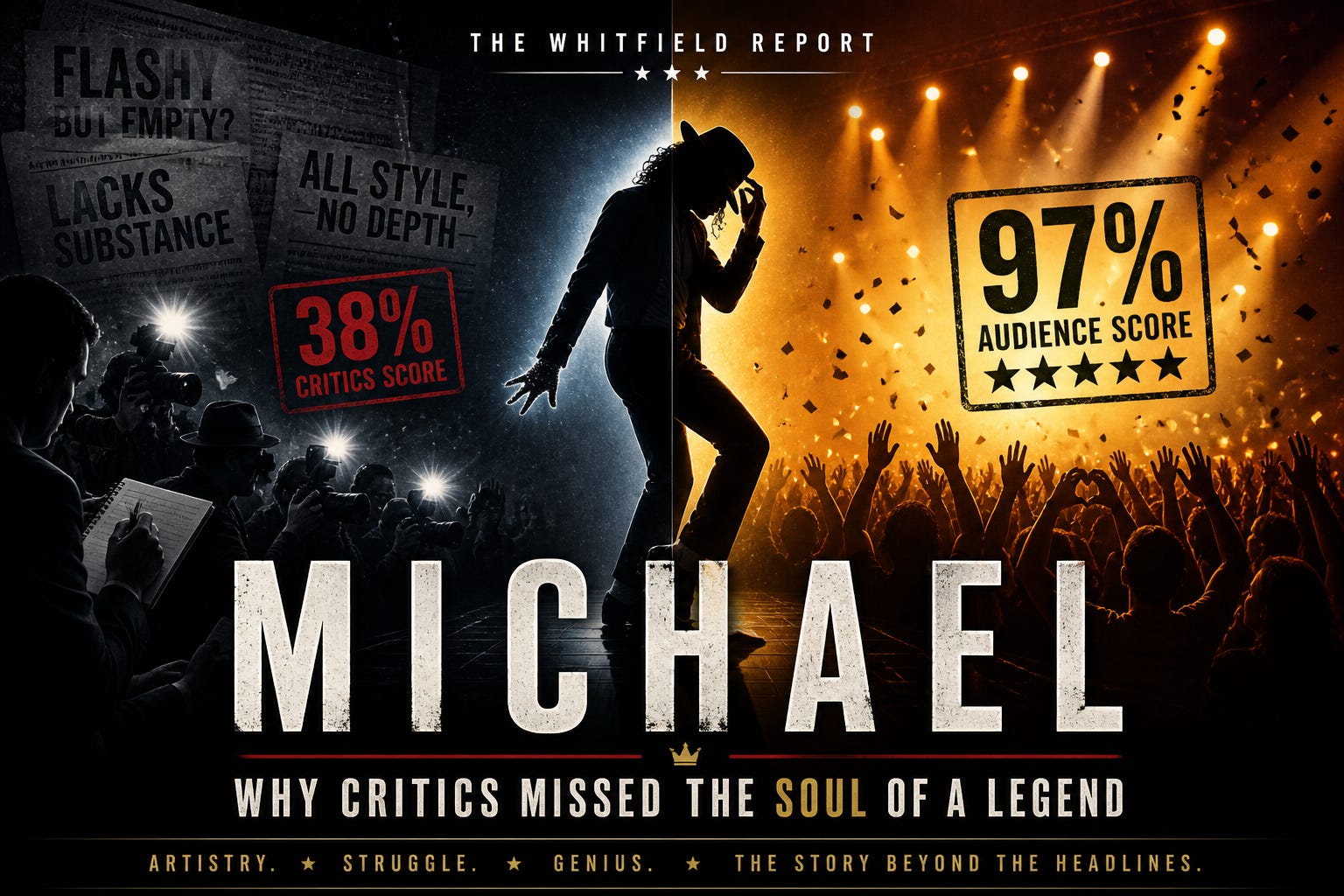
Are biopics meant to simply dazzle with spectacle—or should they offer a deeper look into the lives of the artists they portray?
That question sits at the center of the debate surrounding Michael, the newly released biopic about Michael Jackson. After watching the film this past weekend, one thing became immediately clear: the divide between critics and audiences couldn’t be wider.
With critics hovering around 38% and audience scores soaring near 97%, the question isn’t just whether the film works—it’s why so many reviewers seem to think it doesn’t.
Let’s break that down.
Critics vs. Audiences: A Tale of Two Reactions
The Critics’ Perspective
Major outlets like The Hollywood Reporter have dismissed Michael as style over substance—labeling it flashy, superficial, and overly reliant on spectacle.
But that criticism feels incomplete.
Yes, the film leans heavily into recreating iconic performances—but those sequences are executed with remarkable precision. From the Thriller choreography to the Billie Jean Motown performance, these moments are recreated shot-for-shot, offering a level of authenticity rarely seen in music biopics.
This isn’t empty spectacle—it’s craftsmanship.
Audience Response
Audiences, on the other hand, clearly connected with the film on a deeper level.
Viewers praised its emotional core:
Michael’s turbulent relationship with his father, Joseph Jackson
His close bond with his mother
His early rise through the Jackson 5
These elements provide a grounded, human portrait—something critics seem to have overlooked in favor of broader industry talking points.
More Than Just Glitz
The idea that Michael lacks depth doesn’t hold up under scrutiny.
The film explores Jackson’s formative years with care, showing both the pressure and discipline that shaped him. Joseph Jackson is portrayed not as a caricature, but as a complex, often harsh figure whose influence left lasting scars.
Equally important is the portrayal of Michael’s empathy—his compassion, his connection to others, and the emotional sensitivity that fueled his artistry.
At the center of it all is Jafar Jackson, whose performance is nothing short of remarkable. In his acting debut, he captures not only Michael’s voice and physicality, but his presence. The fact that he performs many of the songs himself—blended with original recordings—adds an extra layer of authenticity.
A Focused Story—By Design
One of the most common criticisms is the film’s decision to omit the controversies that defined Jackson’s later years.
But this isn’t an oversight—it’s a structural choice.
Michael focuses specifically on the Jackson 5 era through the late 1980s, long before the allegations that would dominate headlines in the 1990s. Trying to compress his entire life into a single film would have been both narratively messy and emotionally diluted.
Instead, the filmmakers opted for a two-part approach.
This first installment is about the artist—his rise, his creativity, and his internal struggles. Future installments are expected to tackle the more controversial aspects of his life.
That’s not avoidance. That’s pacing.
The Media Bias Question
The larger conversation here isn’t just about one film—it’s about how certain stories are framed.
Critics often demand that biopics “tell everything,” yet films about artists like Freddie Mercury or Elton John have also taken selective approaches—focusing on music and personal growth rather than exhaustive controversy.
So why is Michael held to a different standard?
There’s a longstanding media fixation on Jackson’s alleged misdeeds—especially after his death—often overshadowing his artistic contributions. Whether intentional or not, that bias seems to shape expectations around this film.
By choosing to focus on his artistry first, Michael pushes back against that narrative—and that may be exactly what some critics are reacting to.
Why You Should Watch Michael
This is a film that deserves to be experienced in theaters.
The sound design, cinematography, and performance sequences are built for the big screen. More importantly, it delivers something increasingly rare in modern biopics: sincerity.
It’s not trying to be a courtroom drama.
It’s not trying to settle debates.
It’s telling the story of a young artist becoming a global icon—and it does so with heart.
Final Thoughts
Michael is a visually stunning, emotionally grounded tribute to one of the most influential entertainers of all time.
It doesn’t attempt to tell the whole story—and it doesn’t need to. What it does instead is focus on the foundation: the talent, the struggle, and the humanity behind the legend.
Critics may have missed the point.
Audiences didn’t.
And if you’re willing to meet the film on its own terms, you’ll likely find it far more substantive than you were led to believe.
Verdict: Two thumbs up.
Looking ahead: Part two, expected in 2027, will likely take on the more controversial chapters of Jackson’s life.
Until then, Michael stands as a compelling first act.